.png)

The anti-ageing IV therapy market in India has grown rapidly — and with that growth has come considerable noise.
Walk into any wellness conversation in Delhi in 2026 and you will hear the names: NAD+, glutathione, NMN, Myers' Cocktail, vitamin C. They are discussed with varying levels of accuracy, frequently overpromised, occasionally dismissed, and rarely ranked against each other with genuine clinical transparency.
That is exactly what this article does.
Below are seven anti-ageing IV drips ranked by the strength of their mechanistic evidence, the quality of clinical data supporting their use, and their specific relevance to the physiological realities of ageing in India. Each ranking reflects what the peer-reviewed literature actually says — with references to support every claim.
If there is one molecule that sits at the intersection of the most important hallmarks of ageing, it is nicotinamide adenine dinucleotide — NAD+.
NAD+ is a coenzyme present in every cell of the human body, functioning as the essential substrate for mitochondrial energy production, DNA repair, and the activation of sirtuins — the family of proteins most directly associated with longevity regulation in the biological literature. It is also the substrate for PARP enzymes, which are responsible for detecting and repairing DNA strand breaks, and CD38, which regulates cellular calcium signalling and immune function. Verdin, 2015
The problem — and it is a significant one — is that NAD+ levels fall by approximately 50 percent between the ages of 40 and 60 in humans. This decline is now recognised across multiple landmark studies as a primary driver of mitochondrial dysfunction, impaired DNA repair, sirtuin silencing, and the systemic metabolic deterioration that defines biological ageing. López-Otín et al., 2013
Restoring NAD+ levels has been demonstrated to reverse measurable aspects of mitochondrial dysfunction, improve muscle insulin sensitivity, enhance cognitive function, and reduce systemic inflammation in clinical populations. Research published in Science by Yoshino et al. (2021) confirmed that NAD+ restoration in prediabetic women improved muscle insulin sensitivity — a core metabolic ageing marker — within ten weeks of supplementation.
At L&B Clinics, NAD+ IV therapy is administered over 2 to 4 hours per session in a monitored clinical environment. It ranks first not because it is the most fashionable anti-ageing therapy — but because its mechanism of action directly addresses more hallmarks of ageing simultaneously than any other single intervention currently available in IV form.
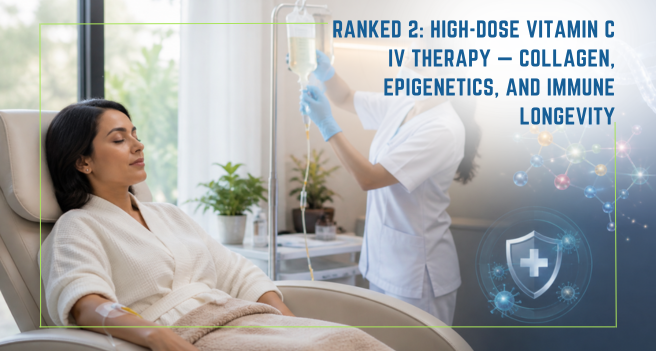
High-dose intravenous vitamin C holds the second position in this ranking because its evidence base is simultaneously among the broadest and most mechanistically precise of any longevity IV intervention.
Vitamin C operates across three distinct longevity-relevant pathways simultaneously.
First, it is the rate-limiting cofactor for collagen biosynthesis — specifically for the hydroxylation of proline and lysine residues that allow the collagen triple helix to form correctly. Without adequate vitamin C, collagen synthesis slows, existing collagen degrades faster, and the structural integrity of skin, blood vessels, joints, and connective tissue throughout the body deteriorates at an accelerated rate. Pullar, Carr and Vissers, 2017
Second — and this is the dimension that positions vitamin C firmly in the longevity medicine conversation — it is an essential cofactor for the TET family of dioxygenase enzymes responsible for DNA demethylation. TET enzymes maintain appropriate epigenetic programming, preventing the age-related drift in gene expression patterns that constitutes one of the primary hallmarks of ageing. Cimmino et al. (2018) demonstrated that TET enzyme activity is directly dependent on vitamin C availability, establishing a mechanistic link between vitamin C status and epigenetic ageing that fundamentally repositions this nutrient beyond its antioxidant role.
Third, IV vitamin C achieves plasma concentrations — up to 70 times higher than the oral ceiling — sufficient to activate immune surveillance mechanisms, support natural killer cell activity, and reduce systemic inflammatory markers that drive immunological ageing. Padayatty et al., 2004
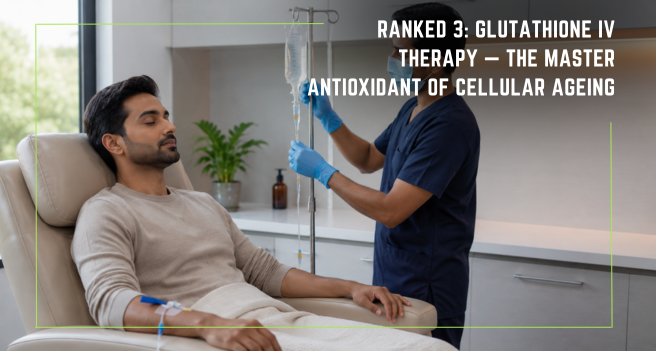
Glutathione earns its third-place ranking through a combination of mechanistic breadth, strong clinical evidence, and particular relevance to the Indian environmental context.
As the body's primary intracellular antioxidant, glutathione operates at the centre of cellular redox balance — neutralising free radicals, regenerating vitamins C and E after their antioxidant cycles, supporting mitochondrial integrity, and driving the liver's phase II detoxification pathways. Its decline with age — by up to 40 percent between young adulthood and the sixth decade — is directly associated with the accumulation of oxidative damage that accelerates virtually every hallmark of ageing. Pizzorno, 2014
The skin brightening effects of glutathione — driven by its inhibition of tyrosinase and consequent reduction in eumelanin synthesis — are well documented and represent a visible clinical marker of the deeper antioxidant restoration it produces systemically. Weschawalit et al., 2017 But framing glutathione exclusively as a skin treatment dramatically undersells its systemic longevity significance.
NMN occupies a distinct and important position in anti-ageing IV therapy — not as an alternative to NAD+, but as a complementary intervention with a growing and increasingly robust clinical evidence base.
NMN is the immediate biosynthetic precursor to NAD+. Unlike oral NMN supplementation — where gastrointestinal absorption and enzymatic conversion efficiency vary significantly — IV NMN enters the bloodstream directly and is converted to NAD+ intracellularly with high efficiency. This makes IV NMN a clinically meaningful route to NAD+ restoration, particularly for patients for whom the longer NAD+ IV sessions are not practical.
Research published in Nature Metabolism by Yoshino et al. (2021) demonstrated that NMN supplementation in postmenopausal women with prediabetes improved muscle insulin sensitivity and skeletal muscle gene expression associated with energy metabolism — changes directly relevant to metabolic ageing in the Indian context, where insulin resistance is prevalent and appears earlier in South Asian populations than in Western cohorts.
At L&B Clinics, NMN therapy is assessed individually. For some patients it is recommended as the primary NAD+ restoration strategy; for others it is integrated alongside direct NAD+ IV therapy in a combined longevity protocol.
The Myers' Cocktail ranks fifth not because it is less important than the interventions above it — but because it is foundational rather than targeted. It is the nutritional platform on which all other anti-ageing IV interventions must operate.
The formulation — magnesium, calcium, B vitamins including B12 and B6, and high-dose vitamin C — addresses the widespread nutritional deficiencies that directly accelerate biological ageing in the Indian population. Magnesium deficiency, present in an estimated 60 percent of Indians due to soil depletion and dietary patterns, impairs the enzymatic function of ATP synthesis, DNA repair, and protein production that all longevity mechanisms depend upon. Rosanoff, Weaver and Rude, 2012
Gaby's (2002) foundational paper on the Myers' Cocktail established its clinical utility across a range of conditions linked to nutritional deficiency — and in the longevity context, its role is as the essential substrate layer of any serious anti-ageing IV protocol.
Alpha-lipoic acid (ALA) is a fat and water-soluble antioxidant synthesised in the mitochondria that occupies a unique and underappreciated position in anti-ageing IV therapy.
Unlike most antioxidants, ALA operates in both aqueous and lipid environments — meaning it provides antioxidant protection across all cellular compartments simultaneously. It regenerates glutathione, vitamins C and E, and CoQ10 after their antioxidant cycles, making it a genuine antioxidant network amplifier rather than a standalone molecule. Packer, Witt and Tritschler, 1995
IV ALA achieves plasma concentrations that oral supplementation cannot approach, and its combination with glutathione and NAD+ in a comprehensive longevity protocol produces synergistic antioxidant and metabolic effects that each intervention achieves less effectively in isolation.
The B-complex IV drip ranks seventh in this anti-ageing ranking — not because its clinical significance is modest, but because it operates most powerfully as a component of broader longevity protocols rather than as a primary standalone intervention.
Its longevity relevance is nevertheless substantial. B vitamins are required at virtually every step of DNA synthesis and repair — the processes that counteract genomic instability, one of the primary hallmarks of ageing. B12 and folate are essential for one-carbon metabolism, the biochemical pathway that produces the methyl groups required for DNA methylation. Deficiency in either produces hyperhomocysteinaemia, an independent risk factor for cardiovascular disease, cognitive decline, and accelerated neurological ageing. Smith, Refsum and Oberholzer, 2000
Biotin — vitamin B7 — is essential for fatty acid synthesis, gluconeogenesis, and the structural integrity of skin, hair, and nails. Its decline with age, compounded by the metabolic demands of stress, illness, and the nutritional gaps common in the Indian diet, directly accelerates the visible and functional markers of ageing that patients most frequently present with.
IV B-complex at therapeutic doses corrects these deficits rapidly and completely — providing the cellular repair infrastructure that makes the body's own anti-ageing mechanisms function at their biological potential.
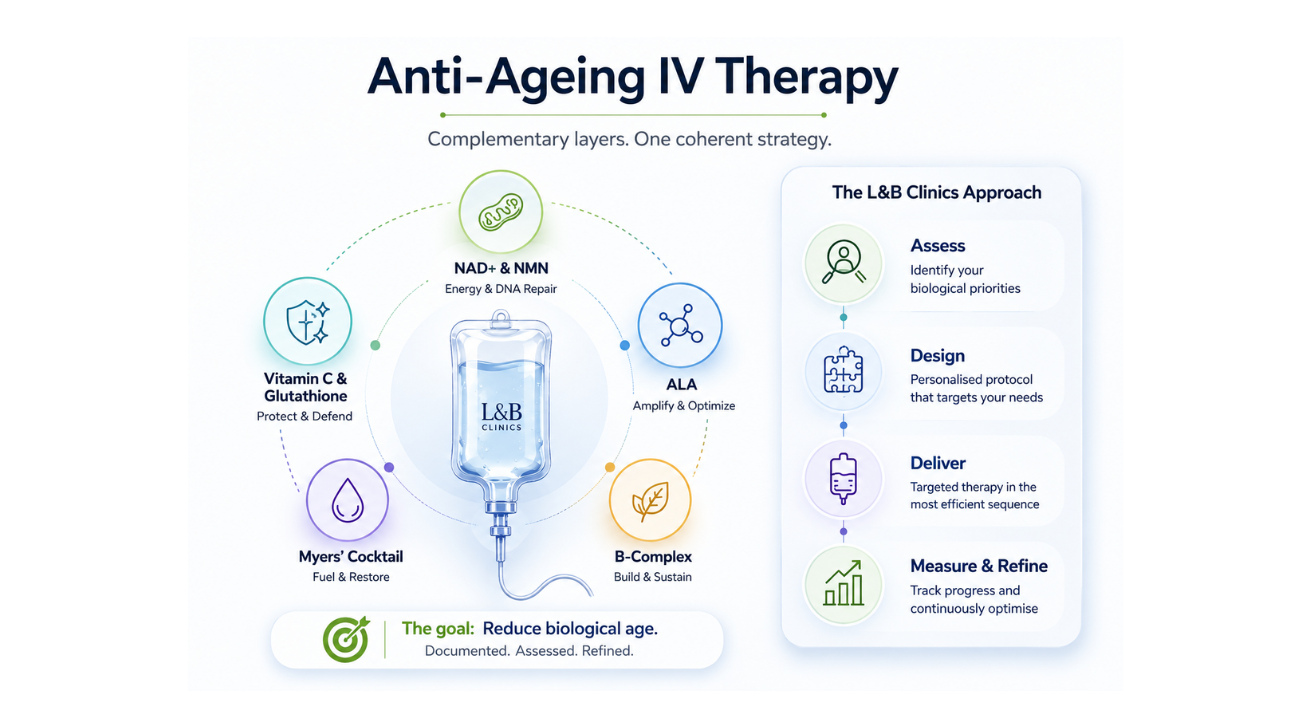
How These Seven Drips Work Together at L&B Clinics
The most important clinical insight in anti-ageing IV therapy is that these interventions are not alternatives to each other — they are complementary layers of a coherent biological strategy.
At L&B Clinics, anti-ageing IV protocols are not selected from a fixed menu. Every patient receives a pre-therapy clinical assessment — and where indicated, advanced biomarker testing — that identifies their specific biological ageing priorities. The protocol is then constructed to address those priorities in the most clinically efficient sequence.
Begin Your Anti-Ageing IV Protocol
Book a clinical assessment at L&B Clinics. Every protocol is personalised — built on biomarker data, not wellness trends.