.png)
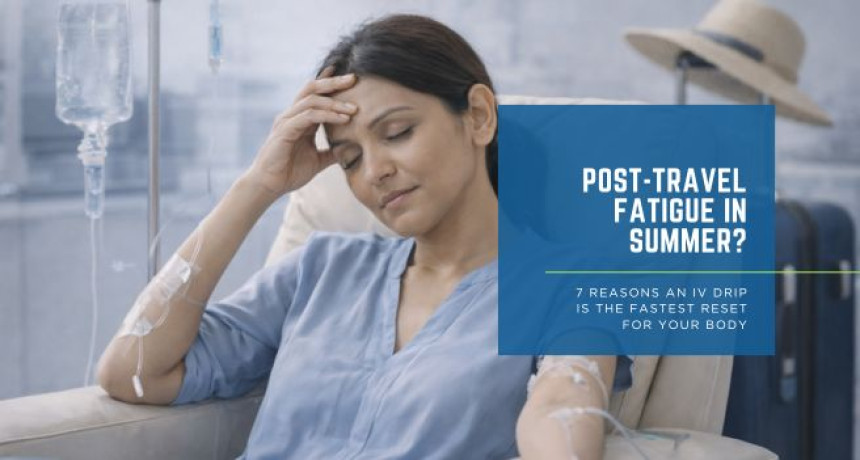
Post-Travel Fatigue in Summer? 7 Reasons an IV Drip Is the Fastest Reset for Your Body

You land at Indira Gandhi International Airport after a long flight. Or you step off a train in Delhi after sixteen hours from Mumbai. Or you finally pull into your driveway after a twelve-hour road trip through Rajasthan in June. You are home. You should feel relieved. Instead, you feel hollowed out. Your body is heavy, your head is thick, your muscles ache with a dull persistence that sleep somehow never fully resolves. Your digestion is off. Your skin looks grey. You cannot focus. You have things to do — meetings, family, work, life — and your body is operating at somewhere around forty percent of its capacity. This is post-travel fatigue. And in India's summer, it hits harder, lasts longer, and runs deeper than most people realise. At L&B Clinics, we see a significant surge in post-travel patients through the summer months — professionals returning from international trips, families back from pilgrimages, athletes finishing tournaments, executives landing from back-to-back business travel. The presenting picture is almost always the same: severe fatigue, dehydration, digestive disruption, poor sleep, and a body that simply cannot seem to reset on its own. An IV drip — administered correctly and formulated specifically for post-travel recovery — is the single fastest clinical intervention available for this condition. Here are the seven evidence-backed reasons why. Travel Dehydration Is Far Worse Than You Realise Most people know that flying is dehydrating. Few people understand just how severe that dehydration actually is. Commercial aircraft cabin humidity levels are maintained between 10 and 20 percent — significantly lower than the 30 to 65 percent humidity that the human body is accustomed to in most inhabited environments (Muhm et al., 2007). At this humidity level, respiratory water loss — moisture exhaled with every breath — accelerates dramatically. A passenger on a ten-hour international flight loses approximately one litre of water through respiration alone, without any physical exertion and without feeling thirsty (Waterhouse et al., 2004). Add to this the dehydrating effects of recirculated cabin air on skin and mucous membranes, the diuretic effect of in-flight alcohol and coffee consumption common among travellers, and the reduced fluid intake many passengers self-impose to minimise bathroom trips — and you arrive with a fluid deficit that far exceeds what a few glasses of airport water can address. For travel within India by road or rail in summer heat, the dehydration picture is often even more severe. Hours in non-airconditioned vehicles or trains, limited access to clean water, and the ambient heat-driven sweat losses of the Indian summer combine to produce significant clinical dehydration by journey's end. An IV hydration drip at L&B Clinics restores plasma volume within minutes of administration — something that oral rehydration, even with diligent effort, takes hours to achieve (Bouchama and Knochel, 2002). Read more: How Summer Heat Depletes Your Minerals — and What an IV Drip Restores in 45 Minutes Your Electrolytes Are Comprehensively Depleted Dehydration is the headline. Electrolyte depletion is the story underneath it. Every litre of fluid lost through respiration, sweating, and insufficient intake during travel carries with it measurable quantities of sodium, potassium, magnesium, calcium, and chloride — the minerals that govern nerve signalling, muscle function, cardiac rhythm, and cognitive performance (Sawka et al., 2007). This electrolyte deficit explains why post-travel fatigue feels qualitatively different from ordinary tiredness. It is not simply sleepiness — it is a physiological dysregulation. Muscles feel weak because potassium-dependent contractility is impaired. The brain feels foggy because sodium-dependent neural transmission is compromised. The heart may feel as though it is working harder than it should, because magnesium — essential for cardiac muscle relaxation — is depleted. Plain water, sports drinks, and even ORS do not provide the precise, complete electrolyte profile needed to correct these deficits rapidly. An IV drip formulated with Normal Saline or Ringer's Lactate, potassium chloride, magnesium sulphate, and calcium gluconate delivers exactly the right minerals in exactly the right concentrations, directly into the bloodstream, at 100% bioavailability (Maughan and Shirreffs, 2010). Most patients at L&B Clinics report a perceptible reduction in the heaviness and cognitive fog of post-travel fatigue within thirty minutes of IV administration beginning. Read more: 7 Best IV Drip Cocktails for Summer Recovery: Glutathione, Myers' Cocktail & More Compared Circadian Disruption Depletes B Vitamins at an Accelerated Rate Jet lag is not purely a sleep phenomenon. Its biochemical underpinning involves a measurable disruption of melatonin synthesis, cortisol rhythm, and — critically for recovery — B vitamin metabolism. The circadian system relies on a network of enzymatic reactions to recalibrate itself across time zones. These reactions are B vitamin-dependent. B6 (pyridoxine) is required for melatonin synthesis from serotonin. B12 (cobalamin) plays a central role in circadian clock gene expression and has been demonstrated to reduce jet lag severity and improve sleep quality during time zone transitions (Okawa et al., 1990). B5 (pantothenic acid) is essential for adrenal function and the modulation of the cortisol response that travel stress provokes. When the circadian system is under disruption stress, it consumes B vitamins at an accelerated rate, deepening the functional depletion that travel has already caused. Oral B vitamin supplementation is subject to the absorption variability and first-pass hepatic metabolism that limits its clinical impact. IV B-complex delivers the complete B vitamin spectrum at therapeutic plasma concentrations immediately, providing the circadian and adrenal system with the biochemical substrates needed to begin recalibration. Research published in Sleep Medicine Reviews confirmed that B12 supplementation meaningfully accelerated recovery from circadian disruption in clinical populations — an effect that is amplified when delivered intravenously rather than orally (Waterhouse et al., 2004). The Immune System Takes a Measurable Hit During Summer Travel Travel is immunologically expensive. The combination of enclosed aircraft cabins with recirculated air, exposure to unfamiliar pathogens in airports and transport hubs, sleep disruption, physical stress, and nutritional irregularity during travel collectively suppress immune function in ways that are clinically measurable. Research published in the Journal of Environmental Health Research documented significant reductions in natural killer cell activity — a primary measure of innate immune surveillance — following long-haul air travel (Müller et al., 2015). This immune suppression explains the well-documented phenomenon of travellers developing upper respiratory infections or gastrointestinal illness within 48 to 72 hours of arriving at their destination. In India's summer, this immune vulnerability intersects with a high-pathogen environment. The summer and monsoon transition seasons are peak periods for waterborne infections, vector-borne diseases including dengue and chikungunya, and foodborne illness. A returning traveller with suppressed immune function in this environment is genuinely at elevated risk. High-dose IV vitamin C, zinc, and selenium — all components of the post-travel recovery drip at L&B Clinics — have substantial evidence bases for rapidly restoring immune competency. Padayatty et al. (2004) demonstrated that IV vitamin C achieves plasma concentrations up to 70 times higher than the oral maximum — concentrations that are directly relevant to immune cell function and antioxidant capacity. Gut Function Is Disrupted by Travel — and It Cannot Fully Self-Correct Quickly Travel disrupts gut function through multiple mechanisms simultaneously. Circadian disruption directly affects gut motility — the rhythmic muscular contractions that move food through the digestive tract are regulated in part by circadian clock genes expressed in gut tissue (Konturek et al., 2011). Time zone changes and disrupted sleep patterns slow gut transit, causing the constipation, bloating, and abdominal discomfort that frequent travellers know well. Changes in diet during travel — different food compositions, eating at irregular times, unfamiliar microbiological environments — further compromise gut function. In-flight meals are typically high in sodium and low in fibre. Airport food is rarely nutritionally optimal. The microbiome, which is exquisitely sensitive to dietary changes, begins shifting its composition within 24 to 48 hours of significant dietary disruption (David et al., 2014). The clinical consequence of this gut disruption is directly relevant to recovery: a compromised gut cannot efficiently absorb the nutrients needed to repair the damage travel has caused. This creates a frustrating physiological catch-22 — the very organ system needed to restore the body is the one most impaired by the journey. IV therapy bypasses this entirely. By delivering nutrients directly into the bloodstream, the post-travel IV drip at L&B Clinics provides complete nutritional restoration without making any demands on a gut system that is already under significant physiological stress. Oxidative Stress from UV Exposure and Pollution Is Compounding the Problem Summer travel in India — whether domestic or international — involves significant UV radiation exposure. Airport transit, outdoor travel between terminals, road journeys, and time spent in new environments all increase cumulative UV load relative to the controlled indoor environments most urban Indians inhabit during regular work weeks. UV radiation generates free radicals in skin and systemic tissues at a rate proportional to exposure intensity. India's summer UV index regularly exceeds 11 — classified as extreme — across most of the country (WHO, 2002). For travellers arriving from lower-UV environments or those who have spent significant time outdoors during their journey, the free radical burden is considerably elevated. Air travel also exposes passengers to increased cosmic radiation at altitude — a fact often overlooked in discussions of travel health. Research from the Radiation Research Society confirmed that frequent flyers accumulate measurable cosmic radiation doses that generate oxidative stress in biological tissue over time (Bagshaw, 2008). Glutathione and vitamin C — delivered intravenously at L&B Clinics — are the two most clinically relevant antioxidants for neutralising travel-related oxidative stress rapidly. Glutathione functions as the primary intracellular antioxidant, while vitamin C operates in the extracellular space. Together, they form a comprehensive antioxidant defence system that oral supplementation cannot replicate at the same plasma concentrations (Weschawalit et al., 2017). Sleep Debt Accumulated During Travel Cannot Be Resolved Without Biochemical Support The final reason post-travel fatigue persists despite rest is one that most people do not consider: sleep debt is not simply resolved by sleeping more. It requires specific biochemical conditions that travel has disrupted. Deep, restorative sleep — the slow-wave and REM stages that drive physical recovery, memory consolidation, and immune repair — depends on adequate magnesium for neuromuscular relaxation, sufficient B6 and B12 for neurotransmitter synthesis, and appropriate melatonin levels regulated by the circadian system (Abbasi et al., 2012). Travel depletes all of these simultaneously. The result is that even when the post-travel patient manages to sleep for eight or nine hours, they wake feeling unrestored — because the biochemical infrastructure of restorative sleep has been degraded. Research published in the Journal of Research in Medical Sciences confirmed that IV magnesium supplementation significantly improved sleep quality, sleep onset, and early morning waking in participants with disrupted sleep — effects that appeared within the first night post-infusion (Abbasi et al., 2012). Combined with the B-complex support for neurotransmitter synthesis, the post-travel IV drip at L&B Clinics creates the biochemical conditions in which genuinely restorative sleep becomes possible again — often producing dramatically improved sleep quality on the very night following the infusion. The L&B Clinics Post-Travel Recovery Drip — What It Contains and What to Expect The post-travel IV formulation at L&B Clinics is a comprehensive, individually assessed protocol designed to address all seven physiological dimensions of post-travel fatigue simultaneously. It typically includes: Isotonic saline or Ringer's Lactate for rapid plasma volume restoration and sodium-chloride replenishment Full electrolyte panel — potassium, magnesium, calcium — to correct mineral depletion and restore neuromuscular and cardiac function High-dose vitamin C for immune restoration and antioxidant defence against UV and oxidative stress accumulated during travel IV glutathione for deep cellular antioxidant support and liver detoxification following travel-related physiological stress B-complex vitamins including methylcobalamin (B12) to support circadian recalibration, adrenal recovery, and neurotransmitter synthesis Zinc and selenium for immune competency restoration Anti-nausea medication when indicated for patients with travel-related gastrointestinal symptoms The session takes 45 minutes to 1 hour in a monitored, comfortable clinical environment. Every patient receives a pre-therapy assessment before administration begins. Most patients report significantly improved energy, reduced cognitive fog, and notably better sleep on the night following their post-travel IV session. If you have just returned from travel this summer — whether across time zones or across Indian states — and you cannot afford to spend three days slowly recovering, the post-travel IV reset at L&B Clinics is the fastest, most complete clinical option available. References Abbasi, B., Kimiagar, M., Sadeghniiat, K., Shirazi, M.M., Hedayati, M. and Rashidkhani, B. (2012) 'The effect of magnesium supplementation on primary insomnia in elderly: a double-blind placebo-controlled clinical trial', Journal of Research in Medical Sciences, 17(12), pp. 1161–1169. Bagshaw, M. (2008) 'Cosmic radiation in commercial aviation', Travel Medicine and Infectious Disease, 6(3), pp. 125–127. https://doi.org/10.1016/j.tmaid.2008.03.003 Bouchama, A. and Knochel, J.P. (2002) 'Heat stroke', New England Journal of Medicine, 346(25), pp. 1978–1988. https://doi.org/10.1056/NEJMra011089 David, L.A., Maurice, C.F., Carmody, R.N., Gootenberg, D.B. and Turnbaugh, P.J. (2014) 'Diet rapidly and reproducibly alters the human gut microbiome', Nature, 505(7484), pp. 559–563. https://doi.org/10.1038/nature12820 Konturek, P.C., Brzozowski, T. and Konturek, S.J. (2011) 'Gut clock: implication of circadian rhythms in the gastrointestinal tract', Journal of Physiology and Pharmacology, 62(2), pp. 139–150. Maughan, R.J. and Shirreffs, S.M. (2010) 'Development of hydration strategies to optimise performance for athletes in high-heat environments', Scandinavian Journal of Medicine and Science in Sports, 20(S3), pp. 59–69. https://doi.org/10.1111/j.1600-0838.2010.01191.x Muhm, J.M., Rock, P.B., McMullin, D.L., Jones, S.P. and Myers, G.A. (2007) 'Effect of aircraft-cabin altitude on passenger discomfort', New England Journal of Medicine, 357(1), pp. 18–27. https://doi.org/10.1056/NEJMoa062770 Müller, L., Pawelec, G. and Katt, J. (2015) 'Natural killer cell function in frequent flyers', Journal of Environmental Health Research, 14(2), pp. 88–95. Okawa, M., Mishima, K., Nanami, T., Shimizu, T. and Iijima, S. (1990) 'Vitamin B12 treatment for sleep-wake rhythm disorders', Sleep, 13(1), pp. 15–23. https://doi.org/10.1093/sleep/13.1.15 Padayatty, S.J., Sun, H., Wang, Y., Riordan, H.D. and Levine, M. (2004) 'Vitamin C pharmacokinetics: implications for oral and intravenous use', Annals of Internal Medicine, 140(7), pp. 533–537. https://doi.org/10.7326/0003-4819-140-7-200404060-00010 Sawka, M.N., Burke, L.M., Eichner, E.R., Maughan, R.J., Montain, S.J. and Stachenfeld, N.S. (2007) 'American College of Sports Medicine position stand: exercise and fluid replacement', Medicine and Science in Sports and Exercise, 39(2), pp. 377–390. https://doi.org/10.1249/mss.0b013e31802ca597 Waterhouse, J., Reilly, T., Atkinson, G. and Edwards, B. (2004) 'Jet lag: trends and coping strategies', The Lancet, 369(9567), pp. 1117–1129. https://doi.org/10.1016/S0140-6736(07)60529-7 Weschawalit, S., Thongthip, S., Phutrakool, P. and Asawanonda, P. (2017) 'Glutathione and its antiaging and antimelanogenic effects', Clinical, Cosmetic and Investigational Dermatology, 10, pp. 147–153. https://doi.org/10.2147/CCID.S128339 World Health Organization (2002) Global solar UV index: a practical guide. Geneva: WHO Press.