.png)
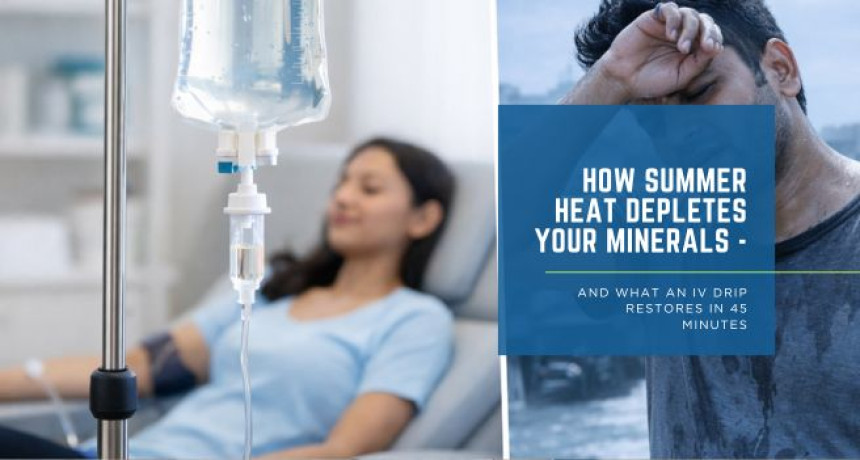
How Summer Heat Depletes Your Minerals — and What an IV Drip Restores in 45 Minutes

Most people think dehydration is simply about water. It is not. When your body sweats through a Delhi afternoon — even a relatively mild one — it does not just lose fluid. It loses a precise cocktail of minerals that govern almost every critical function in your body: your heartbeat, your muscle contractions, your nerve signals, your energy metabolism, your cognitive function, and your immune response. This is why you can drink two litres of plain water in the summer heat and still feel completely drained. The water replaces the volume. It does not replace what your body actually lost. At L&B Clinics, this is one of the most important things we explain to patients arriving fatigued, cramping, or foggy-headed in the summer months. Understanding which minerals are depleted — and why replacing them intravenously works faster than anything you can eat or drink — is the foundation of intelligent summer recovery. The Mineral Crisis Hiding Inside Every Indian Summer India's summer is a physiologically extreme environment. The Indian Meteorological Department recorded heatwave conditions across North India exceeding 44°C in the summer of 2023, with heat index values — accounting for humidity — frequently climbing above 50°C in several states (IMD, 2023). Under these conditions, the average adult loses between 1 and 1.5 litres of sweat per hour during physical activity, and up to 800 ml per hour even at rest in non-airconditioned spaces (Sawka et al., 2007). Each litre of sweat carries with it a measurable concentration of sodium, potassium, magnesium, calcium, chloride, and zinc — minerals your body cannot manufacture and must continuously replenish. When replenishment does not keep pace with loss — which is almost always the case during prolonged Indian summer heat — a state of mineral depletion develops. This is not always dramatic. It rarely announces itself with a crisis. More often, it accumulates silently over days and weeks, presenting as fatigue that sleep does not fix, muscle cramps that come from nowhere, headaches that persist despite hydration, and a cognitive fog that makes simple tasks feel effortful. Research published in the American Journal of Clinical Nutrition established that even mild mineral deficits — well below the threshold of clinical deficiency — produce measurable impairments in physical performance, cardiovascular efficiency, and cognitive function (Volpe, 2013). This is the mineral crisis that Indian summers create, quietly, in millions of people every year. The Six Minerals You Lose First — and What Happens When They Drop Sodium Sodium is the dominant electrolyte in your extracellular fluid and the primary mineral lost through sweat. It governs fluid balance, blood pressure, and the electrochemical gradients that allow nerve cells to fire. Sweat sodium concentration ranges from 20 to 80 mmol per litre, meaning significant losses accumulate rapidly in heat (Maughan and Shirreffs, 2010). When sodium drops, the condition is called hyponatraemia. Even mild forms produce headache, nausea, fatigue, and confusion. Severe hyponatraemia — seen in heatstroke — causes seizures, cerebral oedema, and cardiac arrhythmia (Bouchama and Knochel, 2002). Potassium Potassium is the primary intracellular electrolyte and is essential for muscle contraction — including the rhythmic contraction of the heart. It works in concert with sodium through the sodium-potassium pump, a mechanism responsible for maintaining electrical potential across every cell membrane in the body. Potassium loss through sweat is lower than sodium but clinically significant during prolonged heat exposure. Deficiency — hypokalaemia — presents as muscle weakness, fatigue, constipation, and palpitations. In severe cases, it causes dangerous cardiac arrhythmias (Gennari, 1998). Magnesium Magnesium is arguably the most underappreciated mineral in summer health. It is a cofactor in over 300 enzymatic reactions — including ATP synthesis, the fundamental process by which your cells produce energy (Rosanoff, Weaver and Rude, 2012). It is also lost significantly through sweat, and subclinical magnesium deficiency is already widespread across India due to soil depletion and low dietary intake. Summer heat accelerates this deficit dramatically. The result is muscle cramps, anxiety, poor sleep, fatigue, and headaches — symptoms most people attribute to "general summer stress" without realising a mineral deficit is the driving cause. Calcium Calcium's role extends well beyond bones and teeth. It is essential for neuromuscular transmission — the process by which a nerve impulse triggers a muscle to contract. Sweat-related calcium loss, though lower in concentration than sodium, becomes clinically relevant during sustained heavy sweating. Calcium depletion contributes to muscle spasms, numbness and tingling in the extremities, and — in conjunction with magnesium deficit — disrupted cardiac conduction (Weaver, 2013). Zinc Zinc is a trace mineral with an outsized role in immune function, wound healing, and protein synthesis. It is lost in meaningful quantities through sweat, particularly during exercise in heat. Zinc deficiency impairs T-cell function, reducing the body's ability to mount an immune response — which is part of why summer heat exposure often coincides with increased susceptibility to infections (Prasad, 2008). Chloride Chloride maintains fluid balance alongside sodium and is necessary for gastric acid production and CO₂ transport in the blood. It is lost in parallel with sodium through sweat. Deficiency contributes to metabolic alkalosis, manifesting as fatigue, muscle weakness, and breathing irregularities. Why Oral Replenishment Is Not Enough in Summer This is the point where conventional health advice falls short. The standard response to summer mineral loss — drink more water, have an ORS, eat a banana for potassium — is well-intentioned but clinically incomplete for three important reasons. First, oral absorption of minerals is inherently slow and variable. Minerals consumed through food and drink must be broken down, pass through the gut wall via active transport mechanisms, enter the hepatic portal circulation, and then distribute to tissues. This process takes 30 to 60 minutes under ideal conditions (Gisolfi and Duchman, 1992). Second, heat stress directly compromises gut function. Research from the American Journal of Physiology demonstrates that splanchnic blood flow — circulation to the intestines — drops by up to 40% during sustained heat stress, significantly reducing the efficiency of oral mineral absorption at exactly the time it is most needed (Rao and Summers, 2006). Third, most oral rehydration options do not contain the full spectrum of depleted minerals. Standard ORS replaces sodium and potassium adequately but does not address magnesium, calcium, zinc, or chloride losses in meaningful quantities. What an IV Drip Actually Restores — and in What Timeframe This is where IV therapy changes the equation entirely. A comprehensive mineral replenishment IV drip at L&B Clinics delivers a precisely formulated solution directly into the bloodstream, bypassing the gastrointestinal tract entirely. Every molecule enters circulation immediately, with 100% bioavailability. A standard summer mineral replenishment drip contains: Isotonic Saline or Ringer's Lactate — restores sodium and chloride, expands plasma volume, and re-establishes extracellular fluid balance within minutes of administration. Potassium Chloride — replenishes intracellular potassium stores, normalising muscle contractility and cardiac conduction. Delivered at a carefully controlled rate to avoid any risk of hyperkalaemia. Magnesium Sulphate — the most therapeutically impactful mineral in the summer recovery drip. IV magnesium produces rapid reversal of muscle cramps, reduces headache severity, and restores the enzymatic environment for cellular energy production. Research published in Magnesium Research confirmed that IV magnesium supplementation produces significantly faster correction of deficiency states than oral supplementation across clinical populations (Workinger, Doyle and Borber, 2018). Calcium Gluconate — restores neuromuscular transmission and supports cardiac rhythm regulation, particularly relevant in patients presenting with cramping and palpitations. Zinc and Selenium — trace minerals replenished in therapeutic doses to support immune function and antioxidant enzyme systems stressed by heat and UV exposure. Vitamin C — included as a co-infusion to support the antioxidant environment and enhance the function of zinc and other mineral-dependent immune pathways (Padayatty et al., 2004). B-Complex Vitamins — B vitamins function as cofactors in the enzymatic reactions that minerals drive. Without adequate B vitamins, replenished minerals cannot be utilised efficiently at the cellular level. The entire session at L&B Clinics takes 45 minutes to 1 hour. Most patients notice a measurable improvement in energy, mental clarity, and muscle comfort before the drip is even complete. Who Needs Mineral Replenishment IV Therapy This Summer? While anyone experiencing the Indian summer is losing minerals, certain groups are at significantly elevated risk of developing clinically meaningful depletion: Outdoor workers and construction labourers exposed to direct sun for 6 to 10 hours daily face the highest rates of mineral loss of any population group. Athletes and recreational gym-goers training through summer months, particularly those doing endurance sports, lose minerals at rates that dietary replenishment struggles to keep pace with. Urban professionals working long hours in high-stress environments with poor dietary habits and air conditioning — which itself can be mildly dehydrating — accumulate deficits gradually across the season. Elderly patients whose thirst response is blunted and whose kidney function is less efficient at conserving minerals under heat stress. Patients recovering from illness — typhoid, gastroenteritis, dengue, and viral fever all accelerate mineral depletion through fever-induced sweating, vomiting, and diarrhoea. Vegetarians and vegans who may already carry baseline magnesium and zinc deficits due to dietary limitations and phytate-related mineral absorption interference from plant foods (Pawlak, Parrott and Raj, 2013). The L&B Clinics Approach to Mineral Replenishment At L&B Clinics, IV mineral therapy is never administered without a prior clinical assessment. The formulation is tailored to each patient based on their symptom profile, medical history, and — where indicated — blood panel results. Every session is administered by a licensed medical professional using sterile, single-use equipment in a monitored clinical environment. Drip rate, mineral concentrations, and total volume are determined individually, not applied as a fixed template. If you are experiencing persistent fatigue, muscle cramps, headaches, or cognitive fog this summer — and adequate water intake has not resolved them — the underlying cause is almost certainly mineral depletion, not simply thirst. An IV drip at L&B Clinics can correct what weeks of oral supplementation may fail to achieve, in a single 45-minute session. References Bouchama, A. and Knochel, J.P. (2002) 'Heat stroke', New England Journal of Medicine, 346(25), pp. 1978–1988. https://doi.org/10.1056/NEJMra011089 Gennari, F.J. (1998) 'Hypokalaemia', New England Journal of Medicine, 339(7), pp. 451–458. https://doi.org/10.1056/NEJM199808133390707 Gisolfi, C.V. and Duchman, S.M. (1992) 'Guidelines for optimal replacement beverages for different athletic events', Medicine and Science in Sports and Exercise, 24(6), pp. 679–687. Indian Meteorological Department (2023) Heat wave report — North India summer 2023. New Delhi: Ministry of Earth Sciences, Government of India. Maughan, R.J. and Shirreffs, S.M. (2010) 'Development of hydration strategies to optimise performance for athletes in high-heat environments', Scandinavian Journal of Medicine and Science in Sports, 20(S3), pp. 59–69. https://doi.org/10.1111/j.1600-0838.2010.01191.x Padayatty, S.J., Sun, H., Wang, Y., Riordan, H.D. and Levine, M. (2004) 'Vitamin C pharmacokinetics: implications for oral and intravenous use', Annals of Internal Medicine, 140(7), pp. 533–537. https://doi.org/10.7326/0003-4819-140-7-200404060-00010 Pawlak, R., Parrott, S.J. and Raj, S. (2013) 'How prevalent is vitamin B12 deficiency among vegetarians?', Nutrition Reviews, 71(2), pp. 110–117. https://doi.org/10.1111/nure.12001 Prasad, A.S. (2008) 'Zinc in human health: effect of zinc on immune cells', Molecular Medicine, 14(5–6), pp. 353–357. https://doi.org/10.2119/2008-00033.Prasad Rao, S.S. and Summers, R.W. (2006) 'Managing irritable bowel syndrome', American Journal of Gastroenterology, 101(12), pp. 2590–2599. Rosanoff, A., Weaver, C.M. and Rude, R.K. (2012) 'Suboptimal magnesium status in the United States: are the health consequences underestimated?', Nutrition Reviews, 70(3), pp. 153–164. https://doi.org/10.1111/j.1753-4887.2011.00465.x Sawka, M.N., Burke, L.M., Eichner, E.R., Maughan, R.J., Montain, S.J. and Stachenfeld, N.S. (2007) 'American College of Sports Medicine position stand: exercise and fluid replacement', Medicine and Science in Sports and Exercise, 39(2), pp. 377–390. https://doi.org/10.1249/mss.0b013e31802ca597 Volpe, S.L. (2013) 'Magnesium in disease prevention and overall health', Advances in Nutrition, 4(3), pp. 378S–383S. https://doi.org/10.3945/an.112.003483 Weaver, C.M. (2013) 'Calcium supplementation: is protecting against osteoporosis counter to protecting against cardiovascular disease?', Current Osteoporosis Reports, 11(3), pp. 187–193. https://doi.org/10.1007/s11914-013-0152-2 Workinger, J.L., Doyle, R.P. and Borber, J. (2018) 'Challenges in the diagnosis of magnesium status', Nutrients, 10(9), p. 1202. https://doi.org/10.3390/nu10091202